

Electronics assembly is a high-intensity environment. Long before a product reaches the field, components pass through thermal cycling, solvent cleaning and repeated handling in rapid succession. When durable labels are not engineered to withstand these conditions, failure often occurs – even before final assembly. Adhesives may lift under heat. Print degradation can reduce barcode contrast and interrupt inspection. Loss of legibility can disrupt traceability and introduce rework.

Durability cannot be assumed based on material specifications alone. It must be validated under real process conditions. Performance testing ensures durable labels are engineered to withstand the thermal, chemical and mechanical stresses inherent to electronics manufacturing – protecting traceability, compliance and operational continuity from start to finish.
Manufacturing Stress: The Benchmark for Durability
Whether you’re placing labels and masking for Printed Circuit Boards (PCBs) or box build assemblies, or labeling wire and cable for identification, it’s critical to first understand the stress that your labels must endure in the assembly process.
| Stress Category | Where It Occurs | Primary Risks to Durable Labels |
|---|---|---|
| Thermal Stress | SMT reflow, soldering and curing. | Adhesive softening, edge lift, material distortion, print degradation under temperatures up to 260°C. |
| Chemical Stress | Flux exposure, solvent cleaning, wash cycles (5–20 minutes per cycle). | Ink breakdown, barcode contrast reduction, laminate failure, adhesive degradation. |
| Mechanical Stress | Conveyors, fixtures, manual handling and wire routing. | Abrasion, edge wear, curling, flagging or wrap integrity failure. |
| Environmental Stress | Staging, storage, ambient exposure. | Humidity impact on adhesion, surface contamination, long-term print clarity concerns. |
How Testing Validates Durability and Performance
Because durable labels are exposed to compounded stress during production, validation must reflect the full manufacturing workflow – not isolated test variables.
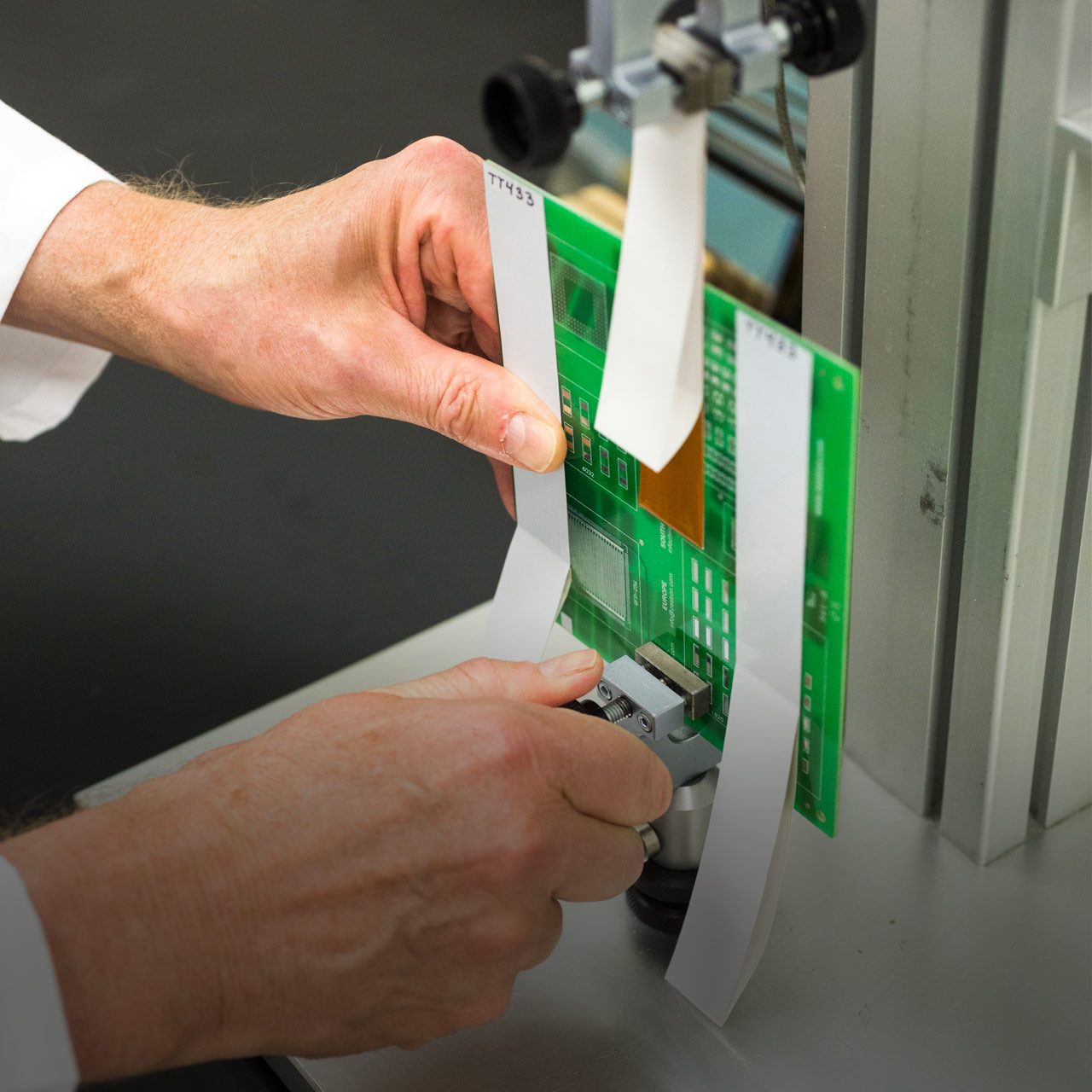
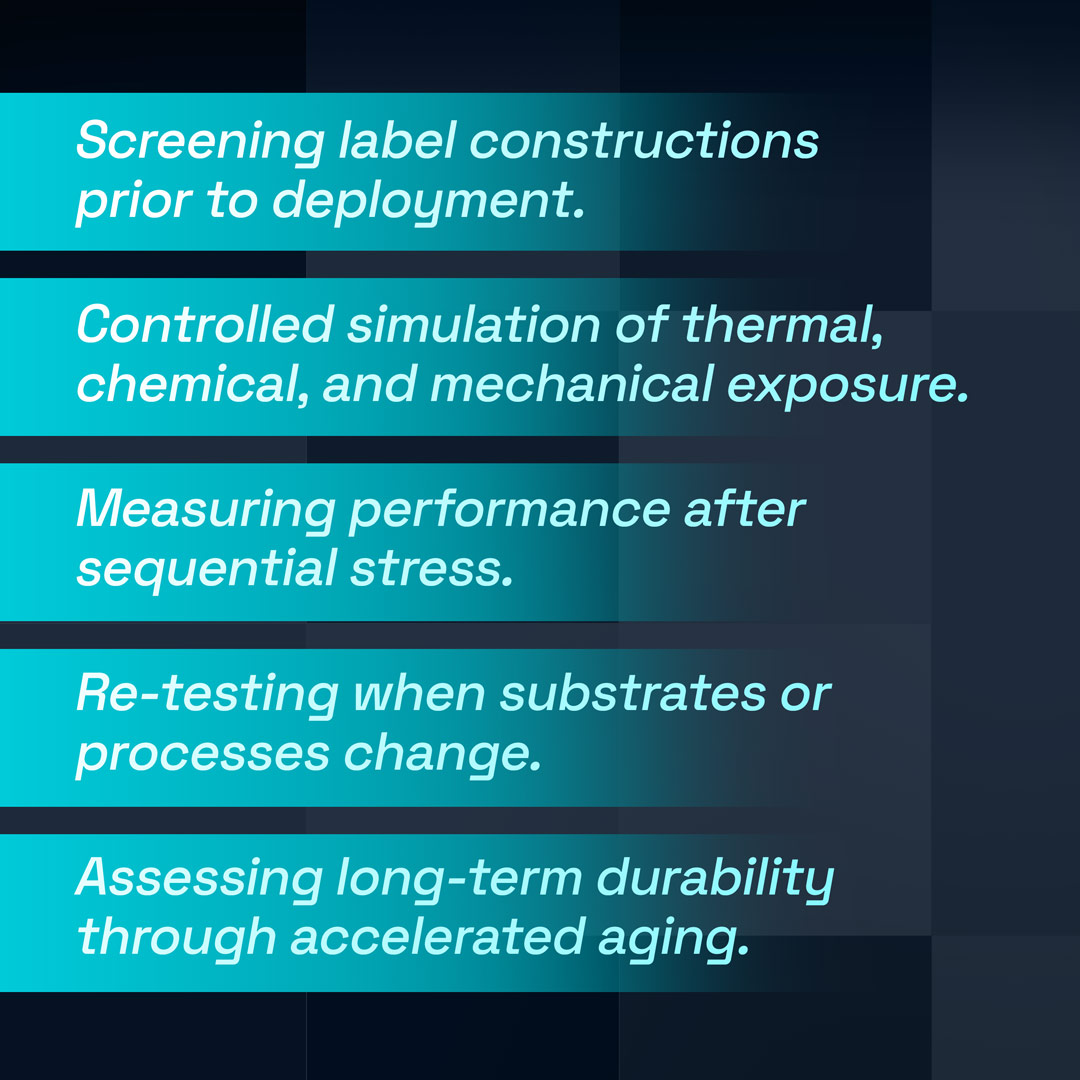
At Armis, validation begins with engineering alignment. Substrate composition, surface energy, thermal profiles and cleaning chemistry are evaluated before a construction is approved for production. Testing is then structured to mirror the manufacturing sequence.

What Performance Testing Validates – and How it Varies by Application
In electronics manufacturing, durable labels must do more than stick. They must remain secure, legible and functional throughout production and into service. Performance testing confirms that identification systems withstand manufacturing stress without compromising usability or compliance.
At Armis, we leverage state-of-the-art in-house testing technologies to measure:
- Adhesion integrity across varying substrate types and surface energy levels.
- QR code / Data Matrix (2D) contrast and serial number retention after sequential exposure.
- Laminate endurance and print clarity following heat, wash and handling.
This structured testing provides validation that durable labels will perform under real manufacturing conditions – not just in the lab. For this reason, testing criteria must be tailored by application.
| Application | Validation Focus |
|---|---|
| PCB Labels | Durable labels must demonstrate high heat tolerance through SMT, wash resistance and secure adhesion to smooth, dense substrates. |
| Wire and Cable ID | Validation focuses on flexibility without cracking, wrap integrity and adhesion to curved or low-surface-energy (LSE) materials. |
| Box Build Assemblies | Testing evaluates adhesion across plastics and metals, resistance to cleaning and handling and appearance durability for visible labels. |
By aligning validation to each use case, Armis ensures durable labels perform where and how they are applied – not just in the lab.
Built to Protect the Systems Behind the Product
Durable labels in electronics manufacturing carry critical information: serialized data, compliance markings and traceability codes that support inspection, regulation and long-term service. When labeling fails, it disrupts communication and increases operational risk.

Through application-specific performance testing, Armis ensures durable labels are validated to perform under real-world conditions. That validation protects data integrity, reduces rework and supports reliable traceability across the full product lifecycle.